New HF Stats 2026 Report Finds Heart Failure Mortality Rising as Disease Increasingly Affects Younger Americans
WASHINGTON, Oct. 5, 2026
Press Release Disclaimer: This is a press release distributed through the XPR Media network. It has not been independently verified by our newsroom.

New HF Stats 2026 Report Finds Heart Failure Mortality Rising as Disease Increasingly Affects Younger Americans
PR Newswire
WASHINGTON, Oct. 5, 2026
Heart Failure Society of America report identifies 12 principal findings defining the changing burden of heart failure in the United States
WASHINGTON, Oct. 5, 2026 /PRNewswire/ — The burden of the disease in the United States continues to grow, with mortality reaching a new peak and younger adults experiencing some of the most concerning increases, according to the new HF Stats 2026: An Updated Report on Heart Failure Epidemiology and Outcomes Statistics from the Heart Failure Society of America (HFSA). Explore the report and principal findings at HFStats.org.
HF Contributed to over 450,000 deaths in the United States in 2023
The 2026 report identifies 12 principal findings that provide a comprehensive picture of the changing state of heart failure in the United States – from lifetime risk, prevalence and mortality to disparities, treatment, cost, specific cardiomyopathies, advanced HF and the workforce needed to care for a growing patient population. Hear 2026 Chair of the HFSA HF Stats Committee Dr. Eiran Z. Gorodeski explain these findings.
Among the most concerning findings, heart failure contributed to 452,573 deaths in the United States in 2023, representing 14.6% of all-cause deaths. Age-adjusted HF mortality increased approximately 37% between 2010 and 2023, reversing more than a decade of previous progress. Early 2024 data suggest that the upward trajectory is continuing.
HF Rates Rising Among Adults Under 65
The report also identifies a significant shift in who is being affected by heart failure. Between 2010 and 2022, HF hospitalization rates increased among adults younger than 65 while declining among adults 65 and older. From 2001 to 2020, crude HF mortality rates increased 121% among adults ages 25–44 and 96% among adults ages 45–64, far outpacing increases among older adults.
“We have made extraordinary advances in our ability to treat heart failure, yet at the population level, the burden of heart failure continues to move in the wrong direction,” said Eiran Gorodeski, MD, MPH, Director of the Advanced Heart Failure & Transplant Center at the University Hospitals Harrington Heart & Vascular Institute in Cleveland, Ohio, and 2026 Chair of the HFSA HF Stats Committee. “HF Stats 2026 shows not only that more Americans are at risk, but that mortality is rising and younger adults are increasingly affected. These findings underscore the urgency of translating what we know into better prevention, earlier recognition, greater use of proven therapies and continued research.”
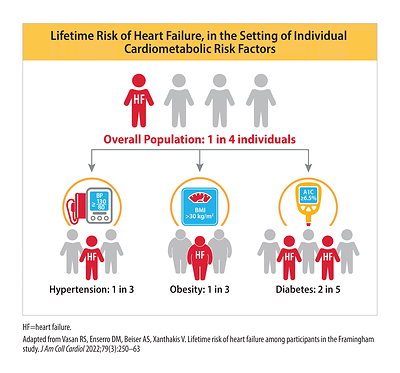
Nearly 1 in 4 Americans will Develop HF
HF remains one of the nation’s most significant cardiovascular health challenges. Nearly 1 in 4 Americans will develop HF during their lifetime, and approximately one-third of U.S. adults without symptomatic HF already meet criteria for Stage A, or at-risk for HF.
Approximately 7.7 million U.S. adults are currently living with HF, representing about 3% of the adult population. That number is projected to increase to 8.7 million by 2030, 10.3 million by 2040 and 11.4 million by 2050, driven in part by an aging population and increasing rates of obesity, hypertension and other cardiometabolic risk factors.
12 Findings Defining the State of Heart Failure in America
HF Stats 2026 identifies 12 principal findings spanning the continuum of heart failure and the systems responsible for its prevention and care.
In addition to rising prevalence and mortality and the increasing burden among younger adults, the report finds:
- Significant racial, ethnic, and geographic disparities persist. Black individuals have the highest age-adjusted incidence of HF and HF mortality rates, while HF prevalence and outcomes vary substantially across states and between rural and urban communities.
- Proven heart failure therapies remain significantly underutilized. heart failure with reduced ejection fraction (HFrEF). Real-world electronic medical record data suggest quadruple guideline-directed medical therapy (GDMT) is used in only 18% of more than 3 million patients with HFrEF.
- The economic burden of HF continues to grow. Depending on the methodology used, estimates range from $46 billion in direct and indirect HF-related costs in 2020 to $312 billion when broader healthcare costs among adults with HF are included. Estimates project substantially higher costs by 2050.
- Specific cardiomyopathies remain underdiagnosed. The report highlights the growing importance of transthyretin amyloid cardiomyopathy (ATTR-CM), hypertrophic cardiomyopathy (HCM) and genetic cardiomyopathies. Genetic causes are estimated to account for 16%–36% of dilated cardiomyopathy.
- Advanced HF and cardiogenic shock remain areas of significant unmet need. Stage D, or advanced HF, affects an estimated 350,000–500,000 U.S. adults, while cardiogenic shock complicates an estimated 60,000–120,000 hospitalizations annually.
- The HF care infrastructure faces mounting workforce challenges. The United States had 1,523 Advanced Heart Failure and Transplant Cardiology-certified physicians as of June 2025, while the report identifies declining Match applicants per position and gaps in multidisciplinary staffing across HF programs.
The 2026 report also expands its examination of populations and conditions with distinct HF risks and outcomes, including older adults, cancer survivors, pregnancy and the postpartum period, genetic cardiomyopathies, ATTR-CM, HCM, cachexia, malnutrition and sarcopenia, as well as end-of-life care. New sections address health-related quality of life in HF and the HF workforce.
From Data to Understanding and Action
HFSA developed HF Stats to provide clinicians, researchers, policymakers, patients, media, and others with an annually updated resource for understanding the scope and changing impact of heart failure in the United States.
The complete HF Stats 2026 report is published in the Journal of Cardiac Failure.
HFSA is also launching an enhanced HFStats.org, making the findings and resources from the report easier to explore and use. The site will feature the 12 principal findings, searchable heart failure data and figures, downloadable resources and a comprehensive slide deck containing figures from the report. Additional resources, including expert videos, fact sheets and infographics, will be added as part of HFSA’s ongoing HF Stats 2026 campaign.
Explore HF Stats 2026 at HFStats.org.
About HF Stats
HF Stats® is an initiative of the Heart Failure Society of America designed to provide an annually updated, comprehensive resource on heart failure epidemiology and outcomes in the United States. The annual HF Stats report is developed by leading experts in heart failure and published in the Journal of Cardiac Failure. HFStats.org provides access to findings, figures, data, and resources designed to help clinicians, researchers, policymakers, media, and others understand and use the latest heart failure statistics.
About the Heart Failure Society of America
The Heart Failure Society of America, Inc. (HFSA) represents the first organized effort by heart failure experts from the Americas to provide a forum for all those interested in heart function, heart failure, and congestive heart failure (CHF) research and patient care. The mission of HFSA is to provide a platform to improve and expand heart failure care through collaboration, education, innovation, research, and advocacy. HFSA members include physicians, scientists, nurses, nurses, nurse practitioners, pharmacists, trainees, other healthcare workers and patients. For more information, visit hfsa.org.
About the Journal of Cardiac Failure
The Journal of Cardiac Failure (JCF) publishes the highest quality science in the field of heart failure with a focus on diversity, equity, and inclusion, mentorship, multidisciplinary partnerships, and patient-centeredness. Published papers span original investigator-initiated work to state-of-the-art reviews, guidelines and scientific statements, expert perspectives, early career and trainee spotlight pieces, patient and patient-partner narratives. JCF also emphasizes the power of language and prioritizes innovative approaches to dissemination of published work to reach and impact the broader heart failure community.
Media Contact: Laura Poko, 301-798-4493, ext. 226, lpoko@hfsa.org

 View original content to download multimedia:https://www.prnewswire.com/news-releases/new-hf-stats-2026-report-finds-heart-failure-mortality-rising-as-disease-increasingly-affects-younger-americans-302898512.html
SOURCE Heart Failure Society of America