New Standard for Logical Quantum Computational Systems (SLQCS)
New Standard for Logical Quantum Computational Systems (SLQCS), establishes a Substrate-Agnostic Framework for
Press Release Disclaimer: This is a press release distributed through the XPR Media network. It has not been independently verified by our newsroom.
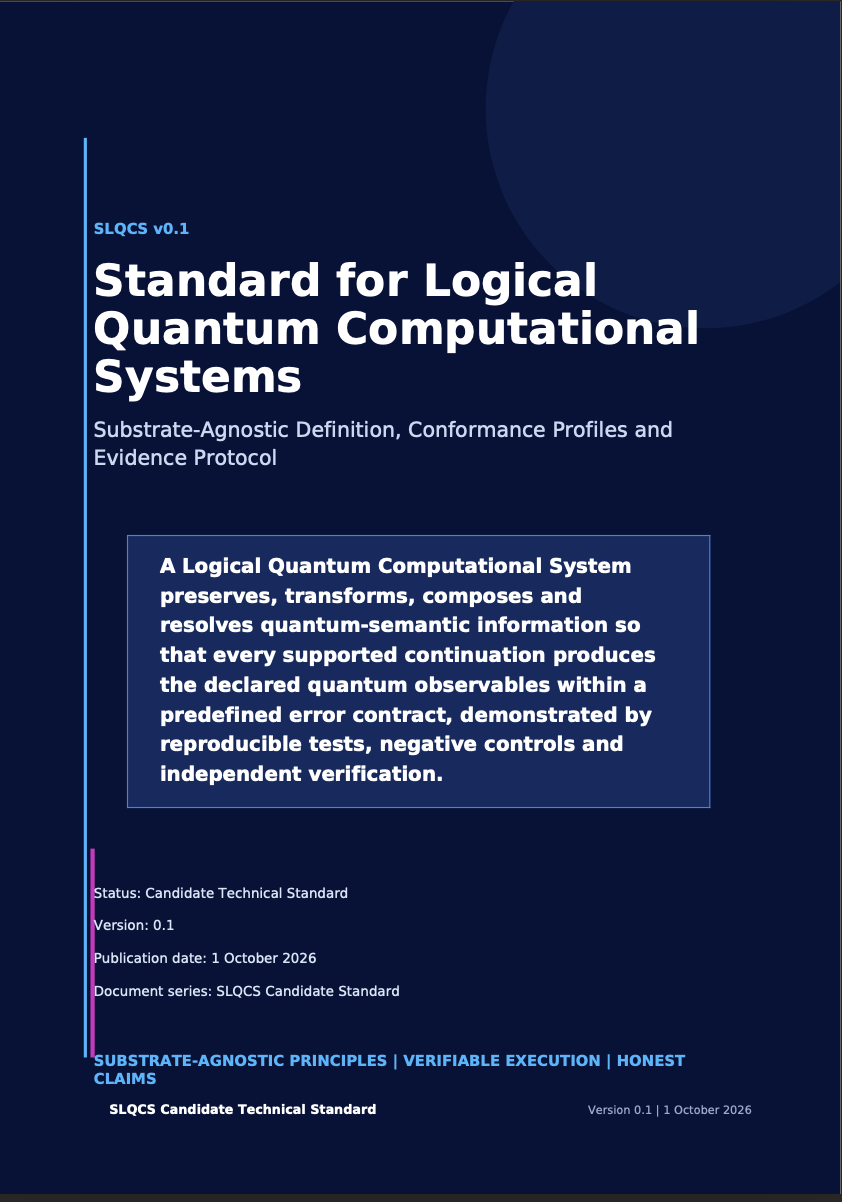

New Standard for Logical Quantum Computational Systems (SLQCS), establishes a Substrate-Agnostic Framework for Verifying Logical Quantum Computation
PETACH TIKVA, ISRAEL, October 1, 2026 /EINPresswire.com/ — New Standard for Logical Quantum Computational Systems (SLQCS), establishes a Substrate-Agnostic Framework for Verifying Logical Quantum Computation
SLQCS v0.1 defines 12 mandatory conformance requirements, a logical-oracle profile, scale-qualification rules and an evidence protocol built around reproducibility, negative controls and independent verification
A new candidate technical standard, the Standard for Logical Quantum Computational Systems (SLQCS) v0.1, has been released for public review and technical evaluation.
SLQCS addresses a foundational question in quantum computing:
What must a computational system actually preserve and execute before it can be described as performing logical quantum computation?
The framework does not define quantum computation by the material from which a machine is built. It applies the same operational requirements to superconducting, photonic, trapped-ion, neutral-atom, spin, topological, digital and hybrid implementations.
Its fundamental criterion is direct:
A logical quantum computational implementation must preserve every distinction required to produce the correct observable consequences under every continuation that its declared execution profile promises to support.
Under SLQCS, matching a single final answer is not enough. A qualifying system must demonstrate that it preserves the information required by future operations, including phase-sensitive behavior, joint relational structure, deferred resolution, conditional evolution, reversibility, measurement semantics and numeric precision.
“Quantum computation should be evaluated by what a system preserves and executes – not by what it is made from,” said Gal Rotem, Co-Founder of DecaQ. “A physical, digital or hybrid implementation should face the same question: does it preserve the distinctions required to produce the correct quantum observables under every continuation it claims to support? SLQCS turns that question into a concrete and falsifiable qualification process.”
Twelve mandatory requirements
The SLQCS core framework evaluates a system across 12 independent requirements:
1. State sufficiency
2. Relative-phase causality
3. Joint relational state
4. Deferred resolution
5. Lawful transformation
6. Measurement and readout semantics
7. Conditional state evolution
8. Reversibility and echo
9. Negative controls and fault injection
10. Numeric contract
11. Scaling preservation
12. Independent verification
Each applicable requirement must satisfy its own predefined tolerance. Strong performance in one area cannot compensate for failure in another.
A formal definition of logical quantum-oracle execution
SLQCS v0.1 introduces a dedicated SLQCS-ORACLE profile and defines a logical quantum oracle as a callable logical operation that implements a declared mapping or transformation inside a quantum computation.
An oracle may be physical, digital or hybrid. It may be primitive or composite. Its qualification depends on its operational action under supported queries and continuations, including controlled application, composition, interference or phase kickback, inversion when declared, and measurement consequences.
The framework explicitly states that returning a known benchmark answer does not establish oracle execution. A precomputed answer, lookup shortcut or hidden use of the expected result that bypasses the declared transformation is nonconforming.
Direct execution is not defined by substrate
SLQCS distinguishes between a simulator and a direct logical implementation through their operational contracts and evidence—not through the hardware category alone.
A simulator models or emulates a separately specified target machine, device, state representation or dynamical model. A direct logical implementation performs the declared logical operations themselves and must satisfy the applicable SLQCS requirements.
Accordingly, a digital implementation running on general-purpose hardware is not automatically classified as a simulator. Equally, use of physical qubits does not automatically establish logical correctness.
“SLQCS is not designed to lower the bar for quantum computing,” Rotem added. “It is designed to make the bar explicit. The framework requires deeper evidence than output matching alone and applies that burden consistently across every substrate.”
Correctness, scale and advantage are separate claims
The standard includes a Complexity Honesty Rule requiring three properties to be reported independently:
• Semantic correctness: whether the system produces the declared quantum observables under the qualified profile.
• Executed scale: the width, depth, structure and class of problems actually run.
• Computational efficiency: the time, memory, energy and cost used relative to the workload and baseline.
None of these properties implies the others. Correct logical execution does not by itself prove quantum advantage. Large width does not prove computational difficulty. Fast execution does not prove that a workload was general or classically hard.
Similarly, SLQCS conformance does not by itself establish physical nonclassicality, physical qubits, operation of a QPU, universal quantum computation, fault tolerance or quantum advantage. Those claims require their own declared profiles and supporting evidence.
A reproducible evidence chain
Every conformance claim must be supported by a versioned evidence package binding:
input → implementation → execution → result → verification
The package includes the declared profile, numeric contract, inputs, implementation version, execution environment, raw results, verification methods, negative controls, observed failures, hashes and an independent evaluator statement where applicable.
The qualification process progresses through five stages: semantic-core testing, independent relational tests, a width-and-depth scale ladder, specialized profile qualification and a blind external run using previously undisclosed inputs and negative controls.
Released for technical review
SLQCS v0.1 is published as a Candidate Technical Standard. It is not presented as an ISO, IEC, IEEE or other accredited consensus standard.
The framework is intentionally vendor-neutral and contains no vendor-specific tests, exemptions or conformance criteria. Researchers, quantum-computing companies, digital-computation developers, independent evaluators, standards specialists and enterprise users are invited to examine the definitions, challenge the criteria and contribute to future revisions.
The full Standard for Logical Quantum Computational Systems (SLQCS) v0.1 is available for public review through DecaQ.ai.
About SLQCS
The Standard for Logical Quantum Computational Systems is a substrate-agnostic candidate framework for defining, qualifying and reporting logical quantum computation. It evaluates systems according to the quantum-semantic information they preserve, the transformations they execute, the observable consequences they produce and the evidence through which those claims can be independently verified.
Substrate-agnostic principles. Verifiable execution. Honest claims.
Media inquiries:
DecaQ
https://decaq.ai/
DecaQ
DecaQ
+97233820954 ext.
email us here
Visit us on social media:
LinkedIn
Legal Disclaimer:
EIN Presswire provides this news content “as is” without warranty of any kind. We do not accept any responsibility or liability
for the accuracy, content, images, videos, licenses, completeness, legality, or reliability of the information contained in this
article. If you have any complaints or copyright issues related to this article, kindly contact the author above.

Media gallery